
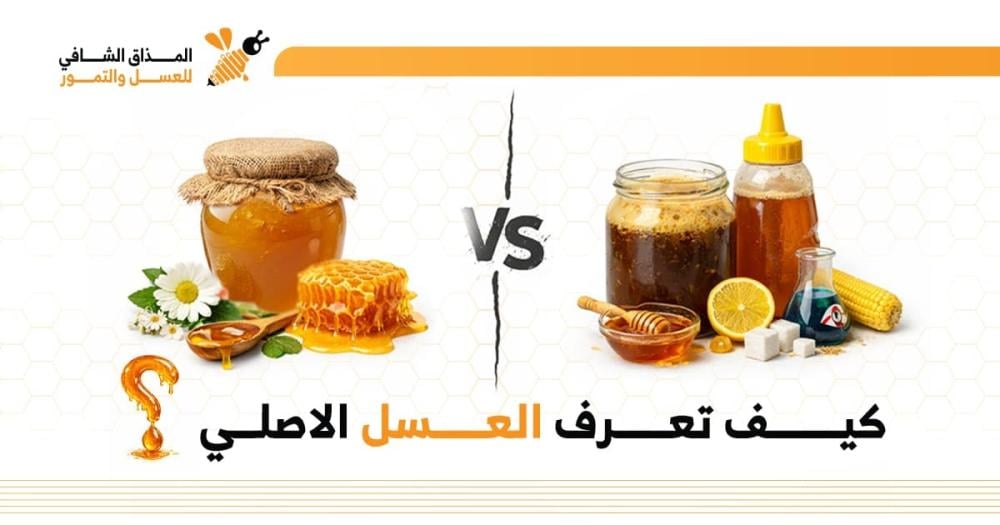

Welcome, honey is one of the oldest natural foods used by humans for thousands of years, and it has been mentioned in holy books for its great nutritional and medicinal benefits. With increasing demand and rising prices, many types of adulterated or artificial honey have spread in the markets, leaving consumers confused about how to distinguish between authentic and unnatural honey. Therefore, knowing the correct methods to detect authentic honey has become essential to protect health and avoid commercial fraud. In this article, we review the most important characteristics that distinguish natural honey, in addition to the most popular simple home tests and modern scientific methods that help ensure the quality and purity of honey.
How to know if honey is 100% real?
With the spread of commercial fraud, it has become difficult for the average consumer to distinguish between authentic honey and adulterated or artificial honey. Therefore, many ask: How do we know if honey is 100% real? The short answer is that there are sensory signs, home tests, and scientific methods that help reveal the quality of honey, but certainty of 100% can only be achieved through laboratory examination. Nevertheless, consumers can achieve a high degree of assurance by using more than one method combined.
How to differentiate between natural and artificial honey?
Natural honey is a direct product of flower nectar collected by bees without industrial intervention, while artificial honey is often a mixture of sugar, glucose syrup, or sweeteners with flavorings and colors.
Key differences include:
- Taste: Natural honey has a balanced, non-pungent taste, while artificial honey is often excessively sweet.
- Texture: Authentic honey is dense and its consistency changes with temperature, while artificial honey remains relatively constant.
- Scent: Natural honey has a light floral or herbaceous scent, while artificial honey is odorless or has an artificial scent.
Color of authentic honey
There is no single fixed color for authentic honey; colors range from light yellow to dark brown depending on the nectar source. Sidr honey is often dark, while floral honey is light in color. The important thing is that the color is natural, not too transparent, and does not look like shiny artificial syrup.
How to identify authentic Sidr honey?
Sidr honey is considered one of the most expensive and finest types of honey, and therefore it is one of the most susceptible to adulteration. Authentic Sidr honey can be identified through a set of signs and tests, but it is always best to combine them and not rely on a single sign:
First: Characteristics of authentic Sidr honey
1. Color
Authentic Sidr honey has a color that is:
- Dark golden to reddish-brown
- Not completely transparent, and the color varies by region and harvest time, but very light color is often not pure Sidr.
2. Scent
- It has a strong, distinctive aroma resembling mountain herbs or wild flowers.
- It does not smell like sugar or caramel.
- The scent becomes more pronounced when gently heated.
3. Taste
- Rich and deep taste
- Not sharp or pungent
- Leaves a warm sensation in the throat with a lingering aftertaste. Adulterated honey tastes only sweet and disappears quickly.
4. Texture
- Dense and heavy when poured
- Flows slowly and forms a continuous stream
- May crystallize partially over time, which is very natural.
Second: Important signs when buying
- Price: Authentic Sidr honey is relatively expensive.
- Source: It is best to buy it from a trusted source such as Al-Madhaq Al-Shafi Store.
- Season: Sidr honey is usually harvested in specific seasons like autumn (but it can be stored and sold throughout the year).
How to identify authentic honey with water?
The water test is one of the most famous home methods. Place a spoon of honey in a glass of water without stirring:
- Authentic honey settles at the bottom and remains cohesive for a period.
- Adulterated honey dissolves quickly and spreads in the water.
Does authentic honey not dissolve in water?
Authentic honey dissolves in water when stirred, but it does not dissolve quickly when dropped directly. The common belief that it never dissolves is not scientifically accurate, but its dissolution method is the key difference.
How to identify authentic honey with fire?
In this test:
- Dip a matchstick in honey
- Then try to light it
If the matchstick ignites easily, it usually indicates that the honey is free from excessive moisture, which is a characteristic of authentic honey.
Does authentic honey burn?
Honey itself does not burn easily due to its water content, but when heated:
- Authentic honey caramelizes and emits a burnt sugar smell.
- Artificial honey may burn quickly or form unnatural foam.
Does authentic honey freeze?
Yes, authentic honey crystallizes or partially freezes over time, especially at low temperatures. Freezing is a natural sign and does not mean the honey is spoiled; on the contrary, it may indicate its purity.
Honey test in the refrigerator
When honey is placed in the refrigerator:
- Authentic honey becomes denser and may crystallize.
- Artificial honey often remains liquid.
Authentic honey test with a tissue
Place drops of honey on a paper tissue:
- If the tissue absorbs the honey quickly and leaves a watery stain, it is likely adulterated.
- If it remains cohesive without leakage, this is a positive sign.
Other methods to detect authentic honey
Bread test
Place a little honey on a piece of bread:
- Authentic honey makes the bread hard.
- Adulterated honey moistens the bread due to added water.
Scent test
Gently heat the honey:
- Authentic honey releases a floral or herbaceous scent.
- Artificial honey only gives off a burnt sugar smell.
Aftertaste test
Natural honey leaves an aftertaste in the throat and gives a warm sensation, while artificial honey's taste disappears quickly.
Method of laboratory honey testing
Laboratory testing is the most accurate method and includes:
- Sugar content analysis
- Moisture measurement
- Natural enzyme examination
- Detection of artificial additives
Authentic honey detection device
Modern devices rely on:
- Electrical conductivity measurement
- Refractive index analysis
- Infrared radiation
These are often used in laboratories or by major honey producers.
General Summary:
It can be said that distinguishing between authentic and adulterated honey is no longer impossible. There are many signs and tests that help consumers form a clear idea about the quality of honey, such as the water test, fire test, refrigeration test, and tissue test, in addition to observing color, taste, scent, and texture. Despite the importance and ease of applying these home methods, they remain approximate indicators that do not provide a 100% definitive judgment. Therefore, laboratory testing and the use of specialized devices are the most accurate and reliable means to ensure the purity of honey and its freedom from adulteration. Choosing a trusted and reputable source, such as Al-Madhaq Al-Shafi Store, remains the most important factor to guarantee obtaining authentic natural honey that combines health benefits with the true taste of honey.
Conclusion: Are home tests sufficient?
In conclusion, home tests are useful and provide strong indications, but they are not sufficient alone for 100% certainty. The best results are obtained by:
- Combining more than one home test
- Buying from a trusted source
- Resorting to laboratory testing when in doubt
Authentic honey is a great blessing, and knowing how to verify it protects your health and your money simultaneously. Good luck to you.