
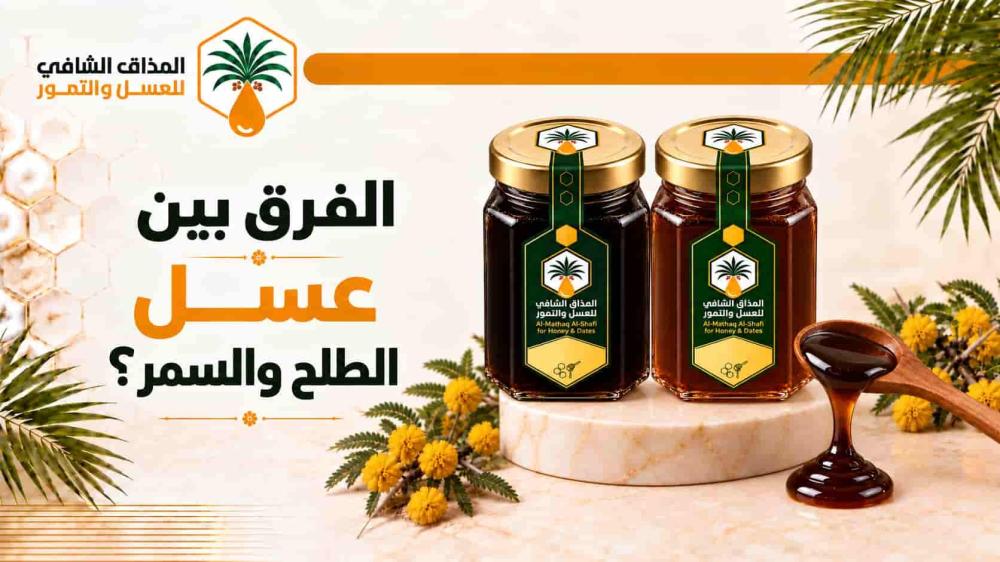

Talh and Samra honey may seem similar at first, but they differ in their nectar source, taste, aroma, color, and some chemical properties. The type of tree and the region where the honey is produced can also affect its final characteristics. Understanding the differences between Talh and Samra honey can therefore help you appreciate what distinguishes each type and choose the honey that suits your taste and preferences.
Is Talh Honey the Same as Samra Honey?
No, Talh honey is not the same as Samra honey. Bees produce each type from the nectar of a different tree, so the two may differ in taste, aroma, color, and some physical and chemical properties.
Talh honey is produced from the nectar of Talh tree blossoms, scientifically known as Acacia gerrardii. Samra honey, also called Shoka honey, is produced from the nectar of the Samra tree, scientifically known as Acacia tortilis. Studies have shown that differences in floral source can affect the composition and characteristics of honey. Although both trees belong to the Acacia group, their honey is not the same.
Differences Between Talh, Samra, and Shoka Honey
Samra honey and Shoka honey are, in fact, two names for the same type of honey, produced from the nectar of Samra tree blossoms. Talh honey is a different type. Although Talh and Samra (Shoka) honey both come from Acacia trees, each has distinguishing characteristics in terms of nectar source, taste, color, and texture.
Below are the main differences between Talh and Samra (Shoka) honey to help you understand what sets them apart and choose the one that suits your taste and preferences.
Differences in Nectar Source
The nectar source is the first and most important difference between the two. Talh honey comes from Talh trees, while Samra (Shoka) honey comes from Samra trees. This difference in nectar source is fundamental to distinguishing between types of honey identified by a single floral source.
In a study of several types of Saudi honey, researchers investigated whether a honey’s source could be identified through its composition. They analyzed honey samples and compared their components, finding differences in some of the constituents of Talh and Samra honey. These differences helped distinguish the two types and showed that the tree from which bees collect nectar can affect a honey’s characteristics and composition.
Differences in Color, Taste, and Aroma
Talh and Samra honey can differ in color, taste, and aroma, although these qualities may vary somewhat with the production region, harvest season, and storage conditions.
- Color: Talh honey tends to be dark amber and may have a deeper, more pronounced color. Samra honey can vary in shade depending on its source and production region, so color alone should not be used to distinguish the two. Studies of Saudi Talh honey have found samples within the dark amber color range.
- Taste: Talh honey has a strong, rich, and distinct flavor, while Samra honey has its own characteristic taste. Sweetness and flavor can vary between samples, making tasting one of the clearest ways to find out which type you prefer.
- Aroma: Talh honey has a noticeable aroma associated with Talh blossom nectar, while Samra honey has a different aroma arising from its nectar source. Aroma, together with taste and color, may give you an idea of the honey’s type, but it cannot confirm its source on its own.
Differences in Texture and Crystallization
There is no fixed rule that Talh honey crystallizes while Samra honey does not, or vice versa. Both can crystallize over time, and the rate depends on the honey’s composition and storage conditions.
- Talh honey: It may remain liquid for a long time, or crystals may form over time depending on its glucose-to-fructose ratio, temperature, and storage conditions.
- Samra honey: It can also crystallize, with the rate of crystallization varying from one sample to another for the same reasons.
Honey crystallization is natural and does not mean the honey is adulterated or spoiled. Likewise, honey remaining liquid does not, by itself, prove that it is authentic.
Differences in Nutritional Composition
Both types contain the natural sugars and minerals found in honey. However, the amounts of certain minerals and plant-derived compounds can differ between Talh and Samra honey depending on the nectar source and region:
- Talh honey: Contains minerals such as potassium, magnesium, iron, and zinc, along with various plant-derived compounds.
- Samra honey: Also contains these elements, but their amounts and overall composition may differ from those in Talh honey.
A study comparing types of honey from the Qassim region found differences in mineral composition and plant-derived compounds between Talh and Samra honey.
Which Is Better: Talh or Samra Honey?
Neither type is universally better than the other. Each has its own taste, aroma, and distinguishing characteristics. Choose Talh or Samra honey based on the flavor you prefer, as well as the honey’s source and quality.
When Should You Choose Talh Honey?
Choose Talh honey if you prefer:
- A dark amber color.
- A strong, rich, and distinct flavor.
- A noticeable, characteristic aroma.
- A texture that may remain liquid for longer, depending on storage conditions.
If these qualities appeal to you, Talh honey from Mathaq Shafi may be a suitable choice.
When Should You Choose Samra Honey?
Choose Samra honey if you prefer:
- Dark-colored honey whose shade varies by source.
- A distinctive, concentrated flavor.
- An aroma that differs from Talh honey.
- Honey that may crystallize naturally over time, depending on its composition and storage conditions.
If you prefer these sensory characteristics, Samra honey may suit you better.
Try Samra (Shoka) honey from Mathaq Shafi and enjoy its quality and flavor.
How Do You Choose Authentic Talh or Samra Honey?
To choose good-quality Talh or Samra honey, do not rely on appearance alone. Check the following:
- Honey source: Choose a product that identifies the type of honey and, where possible, its geographic origin.
- Product information: Check the product name, weight, packaging date, expiration date, and producer.
- Packaging and storage quality: A well-sealed container and proper storage help maintain the honey’s quality.
- Laboratory analysis: When available, a honey analysis can provide more precise information about its characteristics and authenticity.
- Do not rely on a single home test: Water tests, attempts to ignite honey, and similar methods are not reliable on their own for establishing authenticity. Assessing honey quality requires a combination of physical, chemical, and analytical indicators.
You may also be interested in: Benefits of Talh Honey for the Chest and Asthma
Frequently Asked Questions About the Differences Between Talh and Samra Honey
Can You Tell Talh and Samra Honey Apart by Crystallization?
No. Crystals appearing in one type but not the other are not enough to identify the honey or determine whether it is authentic.
Does Talh Honey Taste Different From Samra Honey?
Yes. Their flavors differ: Talh honey tends to have a strong, rich flavor, while Samra honey has a distinctive, concentrated taste.
Do the Benefits of Talh and Samra Honey Differ?
Yes. Some of their potential benefits and nutritional characteristics may differ because the plant-derived compounds, minerals, and antioxidants in each type can vary. They also share the general properties of natural honey.