
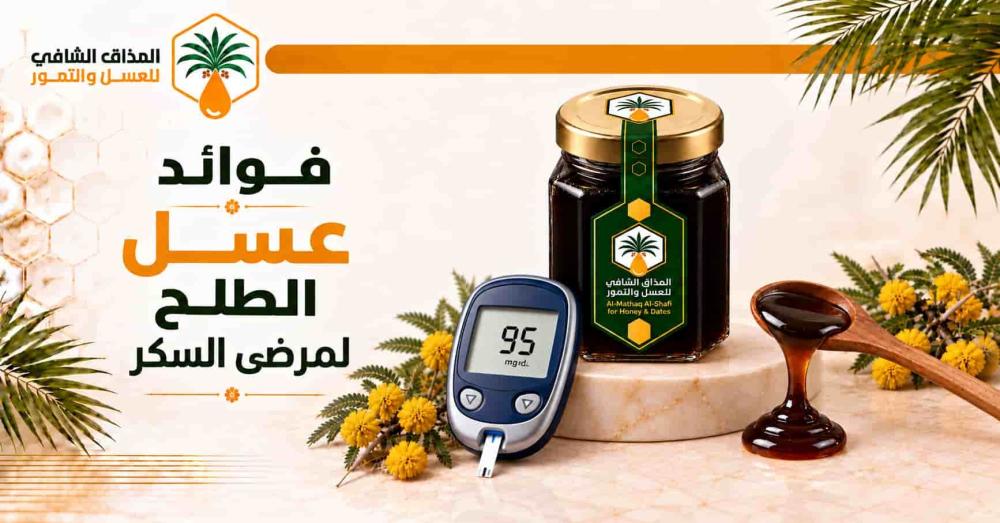

Many people with diabetes look for alternatives to refined sugar that provide a sweet taste without significantly affecting their blood glucose levels. Talh honey is one of the options that often raises questions because of its low sucrose content and its fructose and glucose composition. Is Talh honey truly suitable for people with diabetes? In this article from Mathaq Shafi, we explore its potential benefits, the appropriate amount to consume, ways to use it instead of sugar, and the main situations that require caution or medical advice.
Is Talh Honey Suitable for People With Diabetes?
Yes, but it should be consumed cautiously and in limited amounts. Like most types of natural honey, Talh honey contains natural sugars, primarily fructose and glucose, so consuming it may raise blood sugar levels.
However, honey has a lower glycemic index than refined sugar, which means that blood glucose may rise more slowly after consuming it compared with white sugar. Natural honey can be used as an alternative to refined sugar in carefully measured amounts, but it is not necessarily better for controlling blood sugar. Therefore, it is important to consume an appropriate amount and monitor the body’s response.
Benefits of Talh Honey for People With Diabetes: What Do We Know?
Although honey remains a source of sugar, it contains certain compounds and properties that may benefit people with diabetes when consumed in moderation. These include:
- Relatively low glycemic index: Natural honey raises blood sugar more slowly than glucose or sucrose, which may help reduce rapid spikes in blood sugar after consumption.
- Low sucrose content: Talh honey generally contains a limited amount of sucrose, while fructose and glucose make up the larger proportion. These percentages may vary depending on the nectar source, production region, and honey quality. Therefore, a low sucrose content does not mean that it will not raise blood sugar.
- Antioxidant content: Talh honey contains compounds such as phenols and flavonoids, which may help protect the body against oxidative stress associated with certain diabetes complications.
- Potential support for blood lipid levels: Some studies have shown that consuming honey in moderate amounts may help reduce LDL cholesterol and triglyceride levels compared with consuming refined sugar.
- Potential effect on inflammation: Honey may help increase adiponectin levels, a hormone associated with reducing inflammation and improving blood sugar regulation, which may be beneficial in preventing metabolic syndrome.
However, the amount consumed remains an essential factor. One clinical study found that consuming 50 grams of honey daily for eight weeks caused a slight increase in HbA1c levels among people with type 2 diabetes, despite contributing to a reduction in waist circumference. Maintaining balance and avoiding excessive consumption are therefore essential.
How to Consume Talh Honey for People With Diabetes
Suggested Amount
There is no single amount of Talh honey suitable for everyone with diabetes, as the body’s response varies according to several factors, including:
- The type of diabetes, whether type 1 or type 2.
- The level of blood sugar control and the HbA1c result.
- The medications or insulin doses being used.
- Physical activity and the overall diet.
- Total daily carbohydrate and sugar intake.
General recommendations:
- Start with a small amount, such as half a teaspoon to one teaspoon, equivalent to approximately 3–7 grams, and then check your blood sugar level after two hours to understand your body’s response.
- If your blood sugar is well controlled, your dietary plan may allow you to consume one teaspoon daily, provided that it is counted within your total carbohydrate intake and you follow your doctor’s recommendations.
- If your blood sugar is not well controlled or your HbA1c is above the target range, it is best to avoid honey or consult your doctor before consuming it.
- There is no fixed maximum amount suitable for everyone with diabetes. The appropriate quantity should be determined according to the carbohydrate plan, type of treatment, blood sugar readings, and the guidance of a doctor or dietitian.
- It is important to remember that Talh honey remains a source of sugar despite its low sucrose content. It should not be added to the diet without calculating the amount consumed.
How Can a Measured Amount of Talh Honey Be Used Instead of Sugar?
A carefully measured amount of Talh honey can be used instead of refined sugar in several ways, including:
- In beverages: Use half a teaspoon of honey in tea or coffee instead of a full teaspoon of sugar.
- With yogurt or oatmeal: Add one teaspoon of honey for sweetness, and combine it with nuts or seeds to help slow sugar absorption.
- In recipes: Three-quarters of a cup of sugar can be replaced with half a cup of honey. Reduce the other liquids in the recipe by one-quarter of a cup because honey is naturally liquid.
The flavor and sweetness of honey influence the amount used. Honey with a thick consistency and distinctive flavor may not require a large quantity. This applies to Talh Honey from Mathaq Shafi, a limited amount of which can be added to tea, coffee, or breakfast while counting it toward the daily sugar intake.
Each teaspoon of honey contains approximately 6 grams of sugar and around 20–25 calories. It should therefore be included in the total daily carbohydrate and calorie intake.
When Should a Person With Diabetes Avoid Talh Honey or Consume It With Caution?
It is advisable to avoid Talh honey or consult a doctor before consuming it in the following situations:
- Poor blood sugar control: If the HbA1c result or blood sugar readings are above the target range set by the doctor, it is best to avoid honey or consult a doctor before consuming it.
- Allergy to bee products: People who are allergic to honey or pollen should avoid it completely.
- Type 1 diabetes: Honey may cause a rapid rise in blood sugar, so it should be consumed with extreme caution while accurately calculating the carbohydrates and amount.
- Using diabetes medication or insulin: The amount of honey must be included in the daily carbohydrate intake, and blood glucose should be monitored to avoid unwanted increases or fluctuations while following the doctor’s instructions.
- Weakened immunity: People with weakened immune systems, including some individuals with advanced diabetes, are advised to avoid raw, unpasteurized honey because of the potential risk of bacterial infection.
Conclusion
Talh honey can replace part of the refined sugar in the diet when used in small, carefully measured amounts. However, it remains a source of sugar and carbohydrates, so it must be included in the dietary plan while blood glucose levels are monitored. Honey is not a treatment for diabetes and cannot replace medication or a balanced diet. It is therefore advisable to consult a doctor before making it part of a daily routine.